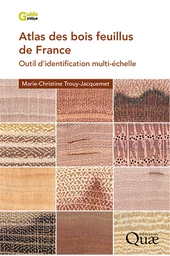
Designed as an identification tool, this atlas describes the woods produced by broadleaved tree species growing in France’s metropolitan forests.
It provides an essential overview for understanding the changes that will increasingly impact not only the species composition of forests but also the growth rate of trees, as well as the quality and density of their wood.
Developed from an exceptional sampling of 114 species — some of them rare — this work uniquely combines a multi-scale approach and explores the relationship between material and resource.
For each species, macroscopic descriptions are illustrated by photographs of a wood cylinder and cross-sections of the wood and bark. At the microscopic level, wood anatomy is described using the criteria defined by the IAWA (International Association of Wood Anatomists).
This work was carried out as part of the XyloDensMap project — a collaboration between INRAE, IGN, and the University of Lorraine — which assessed the biomass of French forests by measuring the basic density of core samples collected during the national forest inventory conducted from 2016 to 2019. The study results are supported by dendrometric measurements provided by the IGN.
All broadleaved forest species recorded during the study period are presented in detail, including currently secondary species that may become dominant in the future.
Like its companion volume, Atlas of Softwood Species of France, this atlas is intended for all forest and wood sector professionals, particularly experts, researchers, educators, and students.