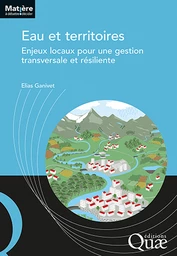




Water and Territories

Local Challenges for Cross-Cutting and Resilient Management

by Elias Ganivet (writer)
december 2025
Référencer ce produit sur votre site

Summary

As water management takes on an increasingly prominent role in public debate, this book proposes to refocus water-related and environmental challenges at the local scale in mainland France.

Drawing on a synthesis of current knowledge, it invites readers to adopt a perspective that is both place-based and cross-cutting, mobilizing the biophysical and social dimensions associated with water—that is, the natural functioning of the water cycle (stocks, flows, etc.), the impacts of human activities and their underlying causes, including issues of governance, regulation, and lifestyle.

The book addresses, in particular, water abstraction and use, changes in land cover, river management, and climate change. It also proposes a number of action levers to strengthen the resilience of territories in the face of current and future crises—whether social, nature-based, or technical solutions.

Intended for policymakers and water-resource managers, and more broadly for anyone seeking to better understand water-quantity issues at the scale of their own territory, this book also provides both theoretical and practical support for the implementation of the scientific mediation tool “Water and Territory Trajectory”, designed to foster dialogue among users and promote the sharing of local knowledge on water.

Table of contents

Acknowledgments

Introduction

Part 1. Understanding Local Water Issues

1. The Water Cycle

– The watershed: the territory of water
– Water stocks and flows within the hydrological cycle
– Evapotranspiration, infiltration, and runoff: three possible pathways for precipitation
– Seasonal variability of the different water flows
– The special case of snowpack and glaciers
– Groundwater
– Groundwater circulation and exchanges with the surface
– The different types of drought

2. Factors Affecting the Water Cycle

– Physical factors
– Biological factors

3. Human Impacts and Their Physical Consequences on the Water Cycle

– Water abstraction
– Water uses
– The urban water cycle
– Changes in land cover and land use
– River engineering and modification
– Climate change
– Interactions between climatic and anthropogenic pressures

4. Social Consequences of Climatic and Anthropogenic Pressures

– Social consequences of climate change
– Social consequences of other anthropogenic pressures
– Toward a cumulative effect of climatic and anthropogenic pressures

Part 2. Identifying Action Levers for Territories

5. Social and Political Solutions

– Using and enforcing the legislative and regulatory framework
– Adapting local governance
– Questioning the territory’s carrying capacity
– Adapting lifestyles
– Economic levers and incentives
– Raising awareness about water issues

6. Nature-Based Solutions

– Adapting urban development
– Preserving and restoring ecosystems
– Adapting agriculture

7. Technical and Technological Solutions

– Wastewater reuse
– Improving water networks
– Water transfers between territories
– Hill reservoirs
– Substitution reservoirs
– Artificial aquifer recharge
– Seawater desalination

Part 3. Sharing Knowledge with “Water and Territory Trajectory”

8. Integrating Local Knowledge into the Tool

– The platform
– The maps
– The cubes

9. Feedback from “Water and Territory Trajectory” Workshops

– Key takeaways
– Main vulnerabilities identified
– Main solutions selected

Conclusion

List of Abbreviations

Bibliography

Image Credits

Press

More contents

Features

Language(s): French

Publisher: Éditions Quae

Edition: 1st edition

Published: 1 december 2025

Reference Book: 03022

Reference eBook [PDF]: 03022NUM

Reference eBook [ePub]: 03022EPB

EAN13 Book: 9782759241569

EAN13 eBook [PDF]: 9782759241576

EAN13 eBook [ePub]: 9782759241583

DOI eBook [PDF] : 10.35690/978-2-7592-4157-6

Interior: Colour

Format (in mm) Book: 145 x 210

Pages count Book: 200

Pages count eBook [PDF]: 200

Weight (in grammes): 280

Size: 16.9 MB (PDF), 6.11 MB (ePub)

Vidéo