


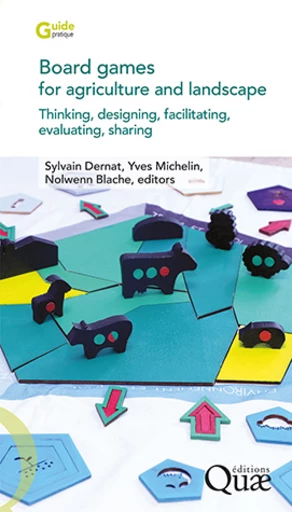
Thinking, designing, facilitating, evaluating, disseminating

de Sylvain Dernat (coordination scientifique), Yves Michelin (coordination scientifique), Nolwenn Blache (coordination scientifique)
Collection : Guide pratique
juin 2026
Référencer ce produit sur votre site

Présentation

There is currently a marked increase in the development of board games related to agriculture and landscape, both in France and worldwide. Too often, however, this enthusiasm leads to isolated initiatives based on trial and error, with varied success that can prove challenging for beginners.

This guide draws on years of collective experience to support the design, facilitation and evaluation of new games in agriculture and land management. The social environment is central to this approach, serving as the driving force behind the gameplay, the resulting learning, and the shifts in attitudes and actions.

The authors provide a highly operational, step-by-step methodical approach for building a game from an initial agricultural or landscape issue, moving from theoretical concepts to evaluation of the final product. Each chapter features a detailed case study to illustrate the design process. Built on decades of expertise, this formalised methodology is designed to be a practical field tool for novice designers everywhere.

This Print On Demand book will be sent within 1 to 2 weeks (metropolitan France) and in a separate package if you order another paperback book.

Sommaire

Acknowledgements

General introduction: games in society

Part 1. Understanding board games to improve their design

1. Key concepts before designing a game

What can we learn from the sciences of games (ludology) and play?
The five dimensions of playing a game
What is a serious game?
What is a board game?
The game as a means of revealing or transforming social space

2. The specificities of games on agriculture and landscape

Playing with agriculture: a great classic
The multiple complexities of agricultural activity
Playing with the landscape adds further complexities

3. Towards a typology of board games designed for agriculture and landscape

Level 1. Education or awareness-raising through board-based games
Level 2. Mutual recognition and building capacity for ‘joint action’
Level 3. Cooperation and commitment for ‘project-making’

Case study thread for Part 1

Part 2. Designing and building a game

4. Before getting started
What is the game about?
What are the game’s objectives?
Who is the game’s audience?

5. Simplifying reality through modelling

How to prepare the conceptual framework for the model
How to organise knowledge into a system
How to take spatial dynamics into account
How to take social phenomena into account
Where to include decision-making centres
How to calibrate the model

6. Creating the game world

Who are the players? Who are the agents?
How do the players interact: competition or collaboration?
How to represent spatial dimensions through the game board
How to integrate temporal dimensions into the game
What place should be given to chance and to the pleasure of playing?

7. Transcribing the model into a game

How to move from model to game materials
How to represent and manage flows of matter and information
How to define the rules of the game
How to spice up the game

8. Testing the game and making necessary improvements

Is the game’s ‘engine’ working properly?
Are the rules clear?
Is the game fluid?
Are the game elements practical?
Is the playing time reasonable?
Does the game perform well?

9. Transforming a game that works into a game that people enjoy

Why good graphic design matters
The special case of ‘sad games’
Are the graphics consistent with the message conveyed by the game?
Does the game correspond to its intended audience?

Case study thread for Part 2

Part 3. Facilitating, evaluating and disseminating a game

10. Facilitating a game session

Some theoretical points of reference
Preparing the game session
The roles of the facilitator

11.Evaluating the game

Some principles of validity for understanding reality
Defining your evaluation: understanding the real
Defining evaluation levels
Assessment tools

12. Devising a strategy for disseminating the game

Valorising your game: questions to consider in advance
Stage A. Baseline profiling of the game to guide valorisation and define an action plan
Stages B1 and B2. Who owns your serious game and how can it be protected?
Conclusion

Case study thread for Part 3

Conclusion

References

List of authors

Lu dans la presse

Annonce

Caractéristiques

Langue(s) : Français

Éditeur : Éditions Quae

Collection : Guide pratique

Publication : 15 juin 2026

Référence Livre papier : 03052

Référence eBook [PDF] : 03052NUM

Référence eBook [ePub] : 03052EPB

EAN13 Livre papier : 9782759242818

EAN13 eBook [PDF] : 9782759242825

EAN13 eBook [ePub] : 9782759242832

Intérieur : Couleur

Format (en mm) Livre papier : 140 x 245

Nombre de pages Livre papier : 164

Nombre de pages eBook [PDF] : 164

Taille(s) : 6,18 Mo (PDF), 5,33 Mo (ePub)

Vidéo