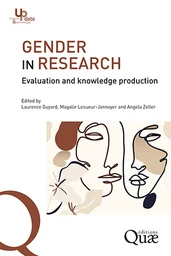



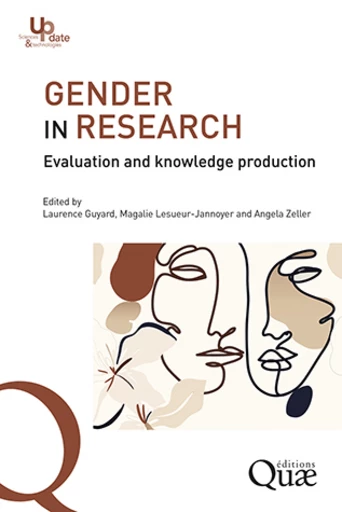
Evaluation and knowledge production

de Laurence Guyard (auteur), Magalie Lesueur-Jannoyer (auteur), Angela Zeller (auteur)
juillet 2026
Référencer ce produit sur votre site

Présentation

Whilst women’s representation in sciences is on the rise, this increase is not of the same scope across all academic fields, such as mathematics or computer science. In addition, the proportion of women decreases at higher levels of the academic hierarchy. 

The persistence of these disparities and inequalities can be explained by the strength of stereotypes and ideological positions maintaining men and women in different and hierarchical social roles. These anchored unconscious stereotypes and gendered representations convey biases that can creep into evaluation processes, be it regarding careers or research projects, and they can also determine and guide scientific approaches. 

Given the complexity of the phenomena leading to the (re)production of inequalities, what measures can be enforced? And how can we ensure their efficiency for the ecosystem as a whole? 

This book—thought as the extension of the Gender in Research colloquium held in December 2020—brings together scientists and funding agencies to address these questions and provide answers. Drawing on a variety of perspectives, depending on whether they emanate from scientists or funders, the contributions offer analyses of different kinds, yet all grounded in a reflexive endeavour. 

This diversity allows to reaffirm that equality is a matter for all stakeholders in the research ecosystem, and their ability to engage in dialogue and collaborate is crucial to guarantee the coherence and efficiency of their actions. 

This book is intended for all the stakeholders involved in the conduct of research and/or its evaluation, regardless of the scientific discipline.

Sommaire

Content
Introduction

Part I - Assessment and potential gender bias

Chapter 1. Gender and assessment of project-based research: the ANR’s commitments and measures

Project-based research funding and assessment issues
The ANR’s commitments and programmes

Chapter 2. Gender and evaluation: analysis of a funding agency

FRS-FNRS, the research funding agency in French-speaking Belgium
Current assessment procedures and their analysis
The feminization of grant holders over recent decades
Success rates and gender
Women under-represented at the top of the academic ladder
Under-representation of women in assessment processes
Conclusion

Chapter 3. Assessing gender bias in the allocation of research funds

Research grants
Gender bias in the allocation process
EUROCORES programmes
Conclusion

Part II - Gender bias in knowledge production

Chapter 4. Gender bias in the production and circulation of knowledge in a development context

Invisibilization of women as research subjects
Gender bias in research and higher education
Marginalization of gender and women’s studies
Transforming power relations in the production and circulation of feminist knowledge
Conclusion

Chapter 5. The sex and/or gender dimension in research projects. Analysis of a test phase at the ANR

Methodology
A very high response rate
Highly contrasting responses
Human resources considerations
The sex and/or gender dimension of research
Conclusion

Chapter 6. Understanding resistance to gender equality: the role of ideologies in justifying the system

Gender stereotypes and the maintenance of social hierarchies
Ideology of intensive mothering
Neoliberal ideology and collective action
Conclusion

Part III - Case studies

Chapter 7. Regulation of sex determination and ovarian differentiation: implications for variations in sexual development

Gonadal sex determination, a key stage in mammalian sexual development
A single embryonic organ, the undifferentiated gonad
Control of gonad differentiation by antagonistic genetic cascades
The objectives of the ANR SexDiff project

Chapter 8. Using gender to improve understanding of links between agriculture and food in farming households

General framework
Gender in research content: design and implementation
Gender in research content: results
Operational implications
Conclusion

Chapter 9. Improving crops using gender-specific consumer-oriented methods

Inclusive approach to the factors determining RTB users’ food product profiles
Conclusion
General conclusion
List of contributors

Lu dans la presse

Annonce

Appréhender l'agriculture numérique 10 ans de recherche interdisciplinaire au sein de l’Institut #DigitAg

Livre papier 30,00 €

Remote Sensing and Spatial Modelling Applications to the surveillance and control of mosquito-borne diseases

Livre papier 26,00 €

Télédétection et modélisation spatiale Applications à la surveillance et au contrôle des maladies liées aux moustiques

Livre papier 26,00 €

Caractéristiques

Langue(s) : Français

Éditeur : Éditions Quae

Publication : 2 juillet 2026

Référence Livre papier : 03065

EAN13 Livre papier : 9782759241224

Intérieur : Couleur

Format (en mm) Livre papier : 160 x 240

Vidéo