


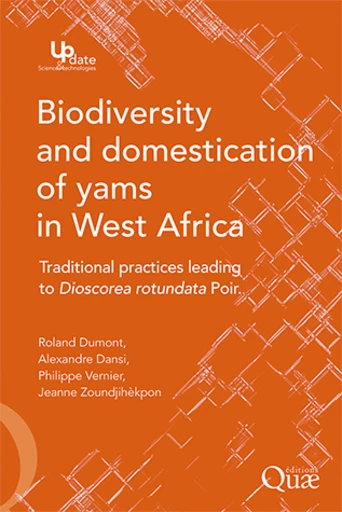
Biodiversity and Domestication of Yams in West Africa

Traditional Practices Leading to Dioscorea rotundata Poir.

de Philippe Vernier (auteur), Alexandre Dansi (auteur), Jeanne Zoundjihèkpon (auteur), Roland Dumont (auteur)
janvier 2006
Référencer ce produit sur votre site

Présentation

This Print On Demand book will be sent within 3 weeks (metropolitan France) and in a separate package if you order another paperback book.

Cet ouvrage en impression à la demande sera envoyé sous 3 semaines environ (France métropolitaine) et dans un colis séparé en cas de commande avec un autre livre papier.

The domestication of wild yams is still common practice in West Africa. It also offers one of the few remaining opportunities to understand how farmers use their empirical knowledge to tap the genetic resources of wild plants and create products suitable for agriculture.

Yam agronomists and breeders have, until recently, focused little attention on this process of organizing and generating agrobiodiversity. This book aims to fill the gap by pooling existing knowledge on the subject. This original field offers a wealth of prospects for scientific progress at a time when scientists are becoming increasingly aware of the fact that local farmers’ knowledge and practices relating to genetic resource management substantially enhances the potential for technical progress and adaptation to environmental change.

The focus is deliberately only on domestication leading to Dioscorea rotundata yams, the type most widely cultivated in West Africa. Several chapters are devoted to the biodiversity of Dioscorea rotundata yams and the wild forms from which they derive.

The authors conclude by putting forward hypotheses to explain the phenotype transformations induced by domestication practices and their maintenance by vegetative propagation. Further research, especially by geneticists, is needed to confirm these hypotheses.

Some are already being assessed, using the most advanced molecular marker analysis techniques, by joint teams of scientists from developed and developing countries.


The French version of this book, Biodiversité et domestication des ignames en Afrique de l’Ouest, is available on our website.

La version française de ce titre, Biodiversité et domestication des ignames en Afrique de l’Ouest, est disponible sur notre site.

Sommaire

Acknowledgements
Foreword

Introduction

The Dioscorea rotundata Poir. yam

Botanical aspects
Geographical distribution
Botanical origins of Dioscorea rotundata
Organization of diversity in Dioscorea rotundata
. Yam diversity on African farms
. State of the scientific knowledge
  Morphological and physiological diversity
  Genetic diversity
  Chemical diversity
  Cooking quality
  Sexual features
  Cultivation requirements
  Intrinsic productivity of the plant material
  Market adaptation

Wild yams Dioscorea praehensilis Benth and Dioscorea abyssinica Hochst ex Kunth

General
Dioscorea praehensilis
Dioscorea abyssinica

Addendum: Dioscorea togoensis Knuth

Phenomena that could explain the variability of wildand domesticated yams

Climatic disturbance
Anthropogenic pressure
Reciprocal gene flow between wild and cultivated yams
Effects of periodic fallows
Variations in genome expression
Mutation
Ploidization

Domestication leading to Dioscorea rotundata

Definitions and general aspects
Rationales and limits of domestication
. Significance and importance of domestication for farmers
. Framework of domestication

Cultivation techniques used to transform wild yams into double-harvest Dioscorea rotundata yams

General
Domestication process and effects
Thoughts on domestication leading to double-harvest Dioscorea rotundata yams

Conclusion

Glossary of technical terms

References

Lu dans la presse

Annonce

Caractéristiques

Langue(s) : Anglais

Éditeur : Éditions Quae

Édition : 1re édition

Publication : 1 janvier 2006

Référence eBook [ePub] : 03030EPB

Référence eBook [PDF] : 03030NUM

Référence Livre papier : 03030

EAN13 eBook [ePub] : 9782759211135

EAN13 eBook [PDF] : 9782759201495

EAN13 Livre papier : 9782759241644

Intérieur : Noir & blanc

Format (en mm) Livre papier : 160 x 240

Nombre de pages eBook [PDF] : 104

Nombre de pages Livre papier : 104

Taille(s) : 4,2 Mo (ePub), 13,4 Mo (PDF)

Vidéo