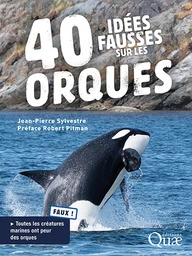



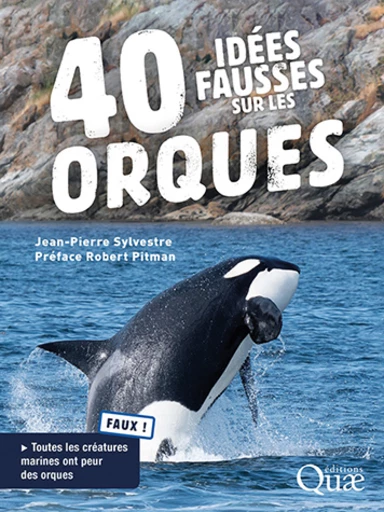
40 misconceptions about orcas

by Jean-Pierre Sylvestre (writer), Robert Pitman (preface)
Collection: Idées fausses
may 2026
Référencer ce produit sur votre site

Summary

In the marine food chain, the killer whale occupies the top of the pyramid. Falsely likened to a killer whale, it has long been reduced to a fearsome predator. This reputation is reinforced by the numerous interactions between killer whales and boats that have taken place in the Strait of Gibraltar since 2020, causing a veritable “killer whale phobia.”

However, the behavior of killer whales in their natural environment and their ecology remain largely unknown to the general public. With an enormous capacity for learning, orcas live in highly structured family groups and exhibit diverse cultural behaviors (communication, hunting techniques, games, etc.). Furthermore, although the species is not globally threatened, environmental changes are putting certain populations at risk.

Summarizing current knowledge about orcas, this book offers a critical perspective on misconceptions about these animals and invites readers to discover their world through immersive and captivating photos.

Table of contents

Foreword by Robert Pitman (Marine Mammal Institute, Oregon State University)

Preface

1 The orca is a fish. FALSE

2 The orca is a whale. FALSE

3 The orca deserves its nickname “killer whale”. FALSE

4 The species was discovered recently. FALSE

5 In the 1st century, Pliny described an orca. QUESTIONABLE

6 The orca has been overlooked by scientists. NEEDS CLARIFICATION

7 The orca does not appear in any mythological bestiary. FALSE

8 Orcas are feared all over the world. NEEDS CLARIFICATION

9 Orcas live mainly in polar waters. NEEDS CLARIFICATION

10 Orcas are not found in French waters. FALSE

11 Orcas live to be barely 50 years old. QUESTIONABLE

12 All orcas are identical. FALSE

13 All orcas have the same behavior. FALSE

14 Orcas live in huge pods. FALSE

15 The social structure of orcas is unchanging. QUESTIONABLE

16 Their mating rituals are violent. FALSE

17 Orcas are champions at holding their breath. FALSE

18 Orcas defend their territory. NEEDS CLARIFICATION

19 Orcas commit group suicide. FALSE

20 Orcas are silent. FALSE

21 Orcas never sleep. FALSE

22 This animal is insatiable! FALSE

23 Orcas have only one hunting technique. FALSE

24 Orcas hunt whales. NEED CLARIFICATION

25 The great white shark is the number one enemy. FALSE

26 All marine creatures are afraid of orcas. FALSE

27 Orcas do not show emotion. FALSE

28 Orcas do not care for their young. FALSE

29 Orcas never leave their natural habitat. QUESTIONABLE

30 Orcas do not exhibit cultural behaviors. FALSE

31 Orcas are the stars of aquariums. FALSE

32 This cetacean adapts well to captivity FALSE

33 Orcas in captivity are docile FALSE

34 Orcas are the bane of the movie industry. FALSE

35 Orcas are dangerous. QUESTIONABLE

36 Humans are prey for orcas. FALSE

37 Orcas avoid humans. FALSE

38 Tragic boat accidents. FALSE

39 Orcas in Gibraltar attack sailboats. NEEDS CLARIFICATION

40 All orcas are endangered. NEEDS CLARIFICATION

Acknowledgments

Image credits

Press

More contents

Features

Language(s): French

Publisher: Éditions Quae

Edition: 1st edition

Collection: Idées fausses

Published: 7 may 2026

Reference Book: 03059

Reference eBook [PDF]: 03059NUM

Reference eBook [ePub]: 03059EPB

EAN13 Book: 9782759241934

EAN13 eBook [PDF]: 9782759241941

EAN13 eBook [ePub]: 9782759241958

Interior: Colour

Format (in mm) Book: 165 x 220

Pages count Book: 120

Pages count eBook [PDF]: 120

Weight (in grammes): 280

Size: 160 MB (PDF), 18.1 MB (ePub)

Vidéo