


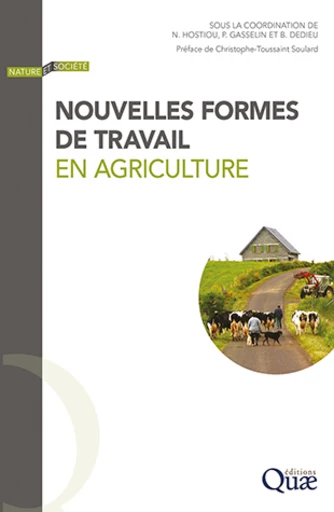
New Forms of Work in Agriculture

by Nathalie Hostiou (editorial coordination), Pierre Gasselin (editorial coordination), Benoît Dedieu (editorial coordination), Christophe-Toussaint Soulard (preface)
Collection: Nature et société
february 2026
Référencer ce produit sur votre site

Summary

French agriculture is undergoing a profound restructuring of its forms of work, with the emergence of new practices, organizations, and professional figures. These plural and heterogeneous transformations remain largely underexplored.

This book sheds light on the diversity of ongoing changes through concrete situations: the development of collective farms, the growing dissociation between land, capital, and labor, the impacts of agroecology and robotization, and the reconfiguration of work collectives around short food supply chains. It also reveals new types of agricultural workers, whether they are neo-farmers from outside the agricultural sector, seasonal and posted workers, volunteers, and even the active role of animals in livestock systems.

Based on an interdisciplinary approach and field-based research, the book offers an original perspective on agricultural work. It differs from analyses focused on employment or legal status by addressing work as it is actually experienced and organized. It renews the debate on agricultural changes by highlighting forms of work that are often invisible and by questioning the sustainability of current models.

This work is the result of a collective effort supported by INRAE’s Sciences for Action and Transitions (ACT) division. This book is intended for researchers, teachers, students, as well as professionals and agricultural development practitioners interested in the dynamics of agricultural work.

Table of contents

Acknowledgments

Foreword

Christophe-Toussaint Soulard

Introduction. Contemporary differentiations in agricultural work

Nathalie Hostiou, Benoît Dedieu, Pierre Gasselin, Lisa Vincent
Responding to current challenges
The aim of the book: to highlight new forms of work in agriculture
Organization of the book
Bibliographical references

PART I – NEW FORMS OF FARM ORGANIZATION

Land holding arrangements and their impact on work in beneficiary farms

Christine Léger-Bosch
Analytical framework and method
Results
Discussion
Bibliographical

2. Collective farms: new forms of agricultural settlement?

Delphine Laurant
Approaching the “collective farm” and work organization issues
Materials and methods
Results: from the creation of a collective to the operationalization of ideals
Discussion
Bibliographical

PART II – NEW AGRICULTURAL PRACTICES

Agroecology in Southern France: implementation hampered by labor costs

Sébastien Bainville, Claire Aubron, Olivier Philippon
Since 1950: a general trend towards labor extensification
Today: contrasting levels of labor intensification and remuneration
Additional labor as a limiting factor for the transition?
Conclusion
Bibliographical

What work configurations in Breton dairy farming are conducive to agroecological transition and collaboration?

Anne-Lise Jacquot, Manon Kister, Marine Dumeix-Toullec, Véronique Lucas
Context, approach and method
Results
Discussion and conclusion
Bibliographical

5. Autonomy at work for livestock farmers. Enhancing semi-natural environments through grazing

Madelleine Johany-Mirabal, Fanny Chrétien, Nathalie Girard, Lucie Gouttenoire
Theoretical framework
Methodology
Results
Discussion and conclusion
Bibliographical

The value of work in agroecological practices: a path to the recognition of agricultural activity

Emmanuel Poussard, Philippe Spoljar, Gérard Valléry
Research on the psychological benefits of new practices
Work issues in the (re)construction of links with society
A material and symbolic link: the fair price of agricultural products
Renewing links through conflictual cooperation
Conclusion
Bibliographical

7. The potential role of social media: supporting farmers in agroecological transition

Celina Slimi, Lorène Prost, Magali Prost, Marianne Cerf
Agroecological transition as a survey to be supported
How can social media contribute to this investigation
Social media’s capacity to trigger inquiry
The potential to induce the investigation is closely linked to the facilitator
Training advisors and facilitators to support survey?
Conclusion
Bibliographical

8. The right machine size: herd size under the threshold of milking robot

Théo Martin
Milking robot: a controversy over dairy farm size
Method and theoretical framework
Threshold effects in milking robot
Conclusion
Bibliographical

9. Itineraries of animal care on farms: an analysis of work organization

Vinciane Gotti, Claire Manoli, Benoît Dedieu
Operational implementation of care: focus on the biotechnical sub-system
A method for studying animal care pathways
A diversity of itineraries of care in the surveyed sample
Discussion: insights from the formalization of itineraries of care
Conclusion
Bibliographical

PART III – NEW WORKERS

10. Italian neo-farmers reinventing work and rural life

Paula Dolci
Participatory tourism as key support for new farmers
In search of unity between work and life
From one “alienation” to another? lifestyle work confronted with precariousness and gender inequalities
Conclusion
Bibliographical

11. Free labor and the establishment of new entrants outside farming backgrounds: invisible realities

Marie Barisaux, Pierre Gasselin, Lucette Laurens
Conceptual framework
Method
Results
Discussion and conclusion
Appendix. Characteristics of surveyed farms
Bibliographical

12. Developing local food supply chains: what challenges for livestock farmers’ work?

Philippine Dupé, Benoît Dedieu, Pierre Gasselin
Conceptual frameworks and method
Results
Discussion and Conclusion
Bibliographical

Bosses in coffee shops without boots: agricultural entrepreneurship among young people of the Moroccan diaspora

Anne Lascaux
Successes and failures of young people from the suburbs in agriculture
“Arab work”? Controversial new agricultural workers
Conclusion
Bibliographical

Cross-border posting of agricultural labor: trust, mistrust and distrust at the heart of a business ecosystem

Béatrice Mésini, Mathieu Coulon
Fides: an innovative “posting” offer between two productive agricultural basins
Bona fides: the socio-economic and spatial deployment of a business ecosystem
Mala fides: intentional offences committed “as an organized group”
Conclusion
Bibliographical

15. Domestic animals: invisible workers

Sébastien Mouret, Vanina Deneux-Le Barh
The animal question: is work a specifically human attribute?
Agriculture and the environment: a reading through animal labor
Conclusion
Bibliographical

Conclusion. Working differently in agriculture: emerging forms and research perspectives

Benoît Dedieu, Pierre Gasselin, Nathalie Hostiou
Transforming the farm: between land-capital-labor dissociations and collective recompositions
Practices in transition: techniques, standards and professional autonomy
Working in agriculture: diversity of figures, invisibility and claims
Understanding NFWA together to envision and guide the futures of agricultural work
Bibliographical

List of Authors

Press

More contents

Features

Language(s): French

Publisher: Éditions Quae

Collection: Nature et société

Published: 19 february 2026

Reference Book: 03042

Reference eBook [PDF]: 03042NUM

Reference eBook [ePub]: 03042EPB

EAN13 Book: 9782759242115

EAN13 eBook [PDF]: 9782759242122

EAN13 eBook [ePub]: 9782759242139

DOI eBook [PDF] : 10.35690/978-2-7592-4212-2

Interior: Black & white

Format (in mm) Book: 150 x 230

Pages count Book: 334

Pages count eBook [PDF]: 334

Weight (in grammes): 660

Size: 11.2 MB (PDF), 5.4 MB (ePub)

Vidéo