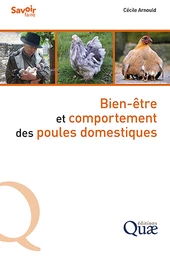



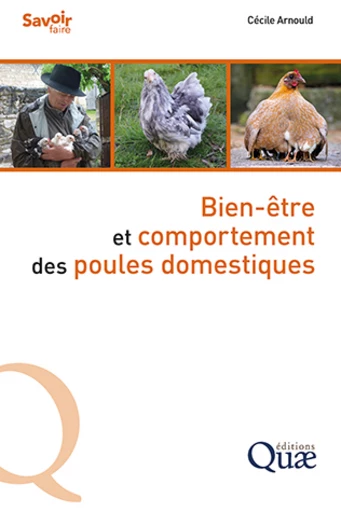
Welfare and behavior of domestic chickens

by Cécile Arnould (writer)
Collection: Savoir faire
february 2026
Référencer ce produit sur votre site

Summary

The number of domestic chickens raised in France reaches several hundred million per year. Whether they are raised for commercial or personal purposes, ensuring conditions conducive to their physical and mental well-being is a crucial ethical issue.

To change the way people view these animals, to encourage everyone to consider their welfare as a necessity and to take action, this book aims to reveal the skills of domestic chickens. Through the rise of scientific research on their welfare and changes in European legislation on their protection, he traces how the sentience of farm animals has gradually been recognized since the second half of the 20(sup)th(/sup) century. He then clarifies the definition of animal welfare and how it can be measured, before detailing the sensory, social, emotional, and cognitive abilities of domestic chickens.

This book draws on more than twenty-five years of the author's experience with domestic chickens of various breeds, living in conditions ranging from thousands of individuals in confinement to a few individuals in semi-freedom. It is aimed at individuals and professionals who breed or work with these birds, as well as anyone who is curious to learn more about them.

Cécile Arnould holds a PhD in ethology and conducts research on the behavior and welfare of farmed birds at INRAE. Among other things, she has carried out expert assessments for the Ministry of Agriculture, the European Food Safety Authority, and the National Reference Center for Animal Welfare. She also participated in the European Welfare Quality® project.

Table of contents

Acknowledgments

Introduction. Why this book?

1. History of awareness of farm animal sentience

Starting point in Europe

Essor of scientific data

Implementation of French and European legislation

In short

2. Well-being: definition and measures

Scientific definitions

Well-being measurement tools

Measurement in livestock farming: operational translations

In short

3. Brief overview of domestic chickens

Birds and well-being

What is a domestic chicken?

In short

4. Sensory abilities and specific characteristics of domestic chickens

Chickens smell and taste!

They have excellent eyesight

They have a very wide hearing range

They have a highly developed sense of touch

They navigate using magnetic fields

In short

5. The domestic chicken, a social animal

Vocalizations as an example of sophisticated communication

Recognition of individuals

Relationship with humans: predators or partners? The choice is yours!

In short

6. The domestic chicken, an animal capable of emotions

Some definitions

Measurement methods

Emotional states in domestic chickens

In short

7. Cognitive abilities of domestic chickens

Chickens have good memories and are capable of learning

They are gifted with behavioral flexibility

They can consider each other's point of view

They can anticipate an event

Could they be empathetic?

What about their personalities in all this?

Consciousness or no consciousness? An open scientific debate

In short

Conclusion

Domestic chickens and different types of farming

Is it relevant to establish boundaries between different species of birds?

Advocating for awareness

In short

Bibliographic references

Press

More contents

Features

Language(s): French

Publisher: Éditions Quae

Edition: 1st edition

Collection: Savoir faire

Published: 26 february 2026

Reference Book: 03043

Reference eBook [PDF]: 03043NUM

Reference eBook [ePub]: 03043EPB

EAN13 Book: 9782759242085

EAN13 eBook [PDF]: 9782759242092

EAN13 eBook [ePub]: 9782759242108

Interior: Colour

Format (in mm) Book: 160 x 240

Pages count Book: 100

Pages count eBook [PDF]: 100

Weight (in grammes): 240

Size: 284 MB (PDF), 2.8 MB (ePub)

Vidéo