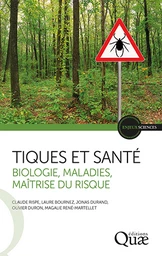



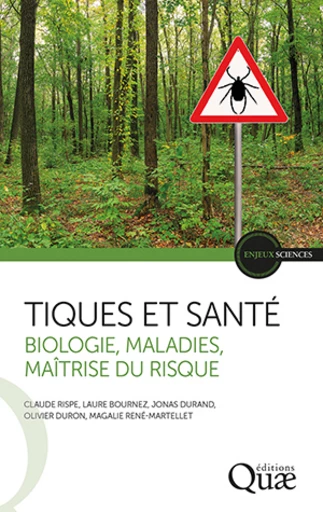
Ticks and Health

Biology, Diseases, and Risk Management

by Claude Rispe (writer), Laure Bournez (writer), Jonas Durand (writer), Olivier Duron (writer), Magalie René-Martellet (writer)
Collection: Enjeux sciences
january 2026
Référencer ce produit sur votre site

Summary

Faced with ecological imbalances and the growing risk of epidemics linked to global change, it is legitimate to examine the role of ticks, which are known to transmit numerous pathogens to humans and animals. They are responsible for a range of diseases, including Lyme disease.

This book first introduces the basic concepts of tick biology and ecology: Where do ticks live, and which hosts do they prefer? How do they locate these hosts, and how do they reproduce? Which pathogens do they transmit? Are all humans equally at risk of being bitten? Which areas are the most heavily infested?

The components of tick-related risk and the methods used to assess and monitor this risk are then explored in detail. The book outlines strategies for reducing it, whether through individual actions (behavioural adaptations, potential use of vaccination) or collective measures (improved management of interface zones between natural and inhabited areas).

This book is intended for anyone who spends time outdoors, as well as for students and teachers. Without alarmism, it encourages an approach grounded in awareness and vigilance.

Table of contents

Acknowledgements

Foreword

Ticks and humans: what is at stake?
A societal issue
Challenges in tropical environments
Lyme disease: what are the impacts?

1. What is a tick?

Where do ticks fit in the animal kingdom?
The tick life cycle
Ticks or mosquitoes: what are the differences?
Which hosts do ticks feed on?
Humans: accidental hosts of ticks
The blood meal and the genetic arsenal of ticks
How do ticks locate their hosts?
How do male and female ticks find each other?
Which ticks thrive in which climates?
Are any tick species endangered?
Sexual reproduction
Do some species reproduce without sex?

2. Which microbes are associated with ticks?

Concepts of vector competence and vector capacity
Are some hosts more competent than others?
Different regions, different species, different diseases
Agents of Lyme disease
Where and when did Lyme disease appear?
Tick-borne encephalitis
Crimean–Congo hemorrhagic fever virus (CCHF)
Anaplasmoses
Other bacterial diseases
Animal piroplasmoses
Lesser-known parasites transmitted by ticks
Are all microbes infectious?
Pathogen or symbiont? divergent trajectories from a common origin
The tick microbiome: an organ-specific ecosystem
Microbiota and the transmission of pathogens

3. How do we define and measure tick-related risk?

How can we understand and monitor risk?
The notion of hazard: where and when are ticks found?
Exposure: the second component of risk
Vulnerability: the third component of risk
How can tick-related risk be characterized and monitored?

4. How can we reduce tick-related risk?

How can hazard be reduced?
Can human exposure be reduced?
How can exposure be reduced in domestic animals?
Environmental impact of acaricides and resistance
Can vulnerability be reduced?
Enjoying nature while staying alert

Bibliographic references

Image credits

Press

More contents

Features

Language(s): French

Publisher: Éditions Quae

Edition: 1st edition

Collection: Enjeux sciences

Published: 2 january 2026

Reference Book: 03037

Reference eBook [PDF]: 03037NUM

EAN13 Book: 9782759242054

EAN13 eBook [PDF]: 9782759242061

DOI eBook [PDF] : 10.35690/978-2-7592-4206-100

Interior: Black & white

Format (in mm) Book: 120 x 190

Pages count Book: 120

Pages count eBook [PDF]: 120

Size: 7.76 MB (PDF)

Vidéo